How to identify each pest, the damage it causes, how to prevent it and when to act. Insecticides are always the last resort.
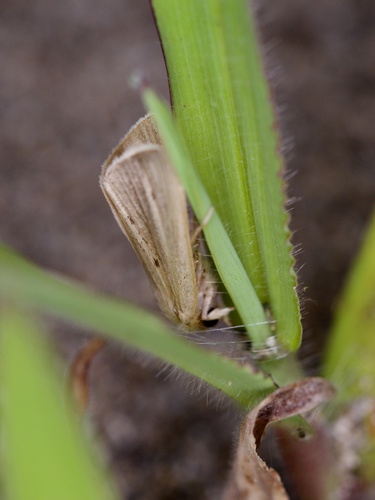
Purple Stem Borer
Sesamia inferens
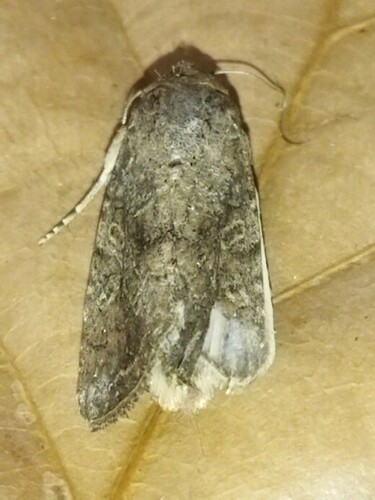
mala rosa na aksip
Photo: (c) りなべる, some rights reserved (CC BY) (CC BY 4.0)
How to identify it
Larva: smooth, without hairs, cream with a pink tinge and a brown head; 30-40 mm when grown.
Adult moth: wingspan about 28 mm, straw-coloured with reddish-brown streaks; hindwings whitish.
Eggs are laid bare between the leaf sheath and stem.
Damage
Deadhearts and whiteheads in rice; also attacks corn and sugarcane.
Prevention
As for other stem borers; keep rice away from sugarcane where possible.
When to act
No published threshold found yet; set one for your farm in the ENTOCULA field map.
Insecticide only as a last resort, when monitoring shows the threshold is reached and natural enemies are not keeping up. Use only FPA-registered products for this crop and pest, at label rate, with protective equipment, and respect the pre-harvest interval. Rotate insecticide groups to slow resistance.
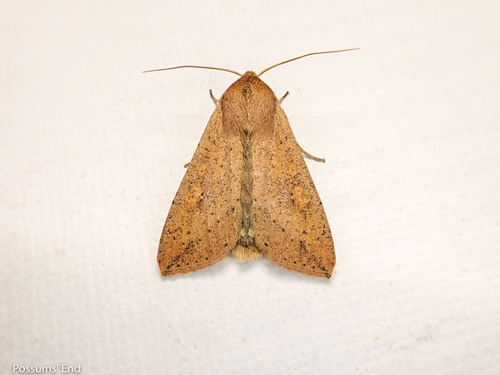
arabas, harabas, tagustos (names used for armyworms)
Photo: (c) Possums' End, some rights reserved (CC BY) (CC BY 4.0)
How to identify it
Larva: up to about 40 mm, with dark and pale stripes along the body.
Adult moth: wingspan 35-50 mm, greyish-yellow forewings with a small white point on the kidney-shaped spot.
Eggs are laid in masses of hundreds.
Damage
Caterpillars eat leaves from the tips and margins, leaving midribs; can cut seedlings at the base and cut panicles. They move in large groups during outbreaks.
Prevention
Flood seedbeds (best defence in rice).
Seedbeds away from large weedy areas; plough fallow land; remove weeds.
Trenches with ash around fields; branches as hiding places for hand-collection.
Natural enemies
Wasps and spiders; avoid killing them.
When to act
Action threshold: 1 larva per plant (maize, India) (Govt. of India (NCIPM, DPPQ&S, NIPHM, 2014): IPM package for Maize)
Insecticide only as a last resort, when monitoring shows the threshold is reached and natural enemies are not keeping up. Use only FPA-registered products for this crop and pest, at label rate, with protective equipment, and respect the pre-harvest interval. Rotate insecticide groups to slow resistance.
Limited sources so far. Check with your municipal agriculturist.
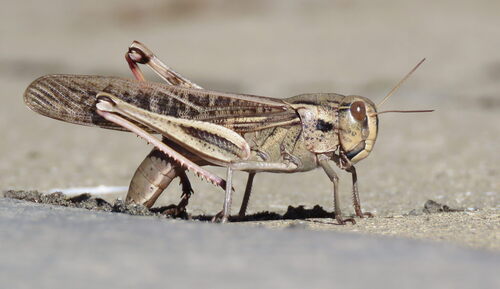
Photo: (c) William Harland, some rights reserved (CC BY) (CC BY 4.0)
How to identify it
Oriental migratory locust: large grasshopper; swarms during outbreaks, usually after drought.
Damage
Feeds on leaves and cuts panicles; swarms can strip fields.
Prevention
Report swarms to the municipal agriculture office immediately.
When to act
No published threshold found yet; set one for your farm in the ENTOCULA field map.
Insecticide only as a last resort, when monitoring shows the threshold is reached and natural enemies are not keeping up. Use only FPA-registered products for this crop and pest, at label rate, with protective equipment, and respect the pre-harvest interval. Rotate insecticide groups to slow resistance.
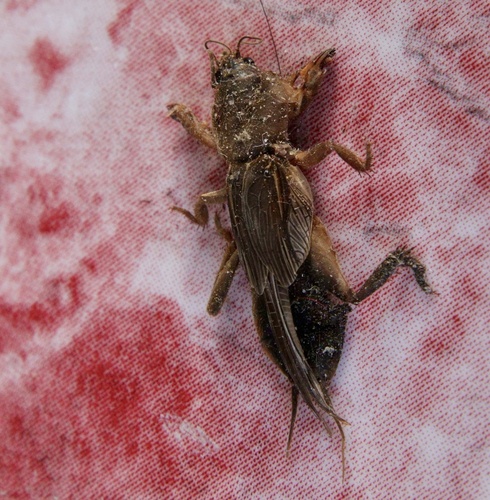
Photo: (c) Casey Clark G. Sumalinog, some rights reserved (CC BY) (CC BY 4.0)
How to identify it
Plump yellowish-brown cricket about 20 mm long with shovel-like front legs for digging; lives in burrows (heaps of soil at entrances).
Damage
Feeds on seeds, roots and stems at the base: missing plants and poor stand in patches.
Prevention
Keep standing water; flood for 3-4 days and level fields.
Avoid raised nurseries.
Collect crickets during land preparation.
Natural enemies
Sphecid wasps, carabid beetles, nematodes and fungi.
When to act
No published threshold found yet; set one for your farm in the ENTOCULA field map.
Insecticide only as a last resort, when monitoring shows the threshold is reached and natural enemies are not keeping up. Use only FPA-registered products for this crop and pest, at label rate, with protective equipment, and respect the pre-harvest interval. Rotate insecticide groups to slow resistance.
Photo: (c) SteveM4560, some rights reserved (CC BY) (CC BY 4.0)
How to identify it
Egg masses: 120-200 eggs under leaves, covered with grey-brown scales from the moth.
Larva: young ones green with a dark head; grown larvae 4-5 cm, brown with three pale lines on the back, dark spots, a pale inverted "Y" on the head and four dark dots in a square near the end of the body.
Adult moth: wingspan 32-40 mm, brown-grey forewing, white hindwing.
Damage
Young larvae scrape leaves leaving thin "windows".
Older larvae make ragged holes and leave moist sawdust-like frass in the whorl; seedlings may be cut.
Larvae boring into ears cause the most serious loss.
Prevention
Plant early and at the same time as neighbours; do not plant next to older corn.
Intercrop with legumes; push-pull (Desmodium between rows, napier grass around).
Crush egg masses and pick larvae by hand on small farms.
Collect and bury crop residues after harvest.
Flowering plants and bird perches support natural enemies.
Biopesticides: Bt (kurstaki), Beauveria, and FAW-specific NPV; best on young larvae.
When to act
Action threshold: 20% infested plants in the first 2 1/2 weeks after emergence (Scouting for fall armyworm (thresholds proposed in Prasanna et al., CIMMYT, 2018))
Action threshold: 40% infested plants from about 3 weeks to tasselling (Scouting for fall armyworm (thresholds proposed in Prasanna et al., CIMMYT, 2018))
Insecticide only as a last resort, when monitoring shows the threshold is reached and natural enemies are not keeping up. Use only FPA-registered products for this crop and pest, at label rate, with protective equipment, and respect the pre-harvest interval. Rotate insecticide groups to slow resistance.
Photo: (c) Licheng Shih, some rights reserved (CC BY) (CC BY 4.0)
How to identify it
Eggs: in groups under leaves, hatching in 3-4 days.
Larva: pinkish with dark spots when young; later yellow-brown with dark spots, up to about 29 mm.
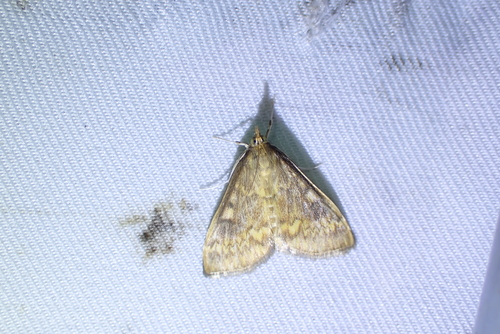
Adult: female pale yellow-brown with wavy darker bands, male darker.
Damage
Young larvae feed in the whorl (pinholes on leaves), then in the tassel.
Older larvae bore into stalks and ears; frass at holes; leaves above entry holes wilt; broken tassels and stalks.
Prevention
Synchronised and early planting (the most widely used practice in the Philippines).
Detasselling of 75% of plants removes many larvae.
Sanitation: destroy stalks and residues.
Natural enemies
Release Trichogramma evanescens egg parasitoid cards (70-100 cards per hectare) when 3-5 egg masses per 100 plants are found at 20-25 days after planting; repeat weekly 2-3 more times if egg parasitism stays under 20%.
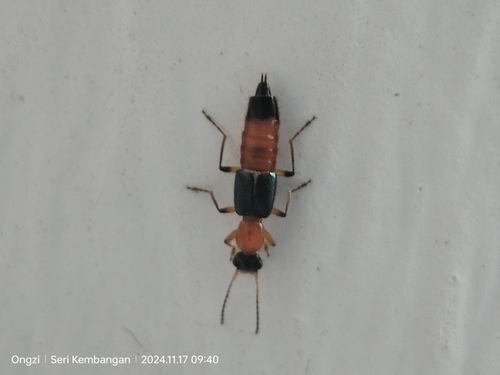
Release the predatory earwig Euborellia annulata 2-3 times at weekly intervals from 25-46 days after planting.
Planting spiny amaranth around the field supports the flower bug Orius tantillus, which eats eggs and small larvae.
Bt (Bacillus thuringiensis) sprays.
When to act
Release trigger: 3-5 egg masses per 100 plants at 20-25 DAP: release Trichogramma (Javier, Quimio & Bato (2002) Recommendations for the management of major arthropod pests of sugarcane and corn. Philippine Entomologist 16(2):129-145)
Action threshold: 40% of plants with damage symptoms: whorl treatment or Bt (Javier, Quimio & Bato (2002) Recommendations for the management of major arthropod pests of sugarcane and corn. Philippine Entomologist 16(2):129-145)
Insecticide only as a last resort, when monitoring shows the threshold is reached and natural enemies are not keeping up. Use only FPA-registered products for this crop and pest, at label rate, with protective equipment, and respect the pre-harvest interval. Rotate insecticide groups to slow resistance.
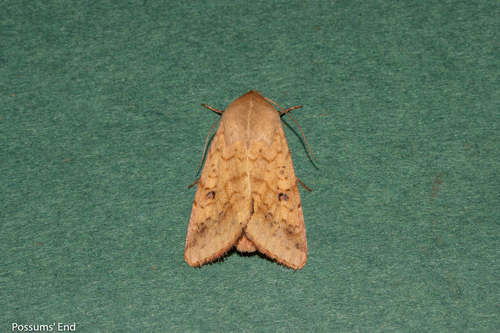
Photo: (c) Possums' End, some rights reserved (CC BY) (CC BY 4.0)
How to identify it
Eggs: round, ribbed, 0.4-0.6 mm, white turning greenish, laid singly on silks, buds and young parts.
Larva: very variable colour (green, yellow to red-brown) with dark broken stripes along the side; up to 40 mm.
Adult moth: wingspan 30-40 mm; forewings yellowish to orange (female) or greenish-grey (male); hindwings pale with a dark band at the edge.
Damage
Corn: feeds on silks and kernels at the ear tip.
Tomato and chili: young larvae eat leaves, then bore round holes into fruits and hollow them out.
Prevention
Field sanitation; rotate with non-host crops.
Marigold as a trap crop (e.g. one row per 18 rows of chili); maize or sorghum guard rows.
Bird perches; pheromone traps (4-5 per acre) to follow moth flights.
Natural enemies
Trichogramma egg parasitoid releases from flowering; Bt and Helicoverpa NPV sprays; neem.
When to act
No published threshold found yet; set one for your farm in the ENTOCULA field map.
Insecticide only as a last resort, when monitoring shows the threshold is reached and natural enemies are not keeping up. Use only FPA-registered products for this crop and pest, at label rate, with protective equipment, and respect the pre-harvest interval. Rotate insecticide groups to slow resistance.
Limited sources so far. Check with your municipal agriculturist.
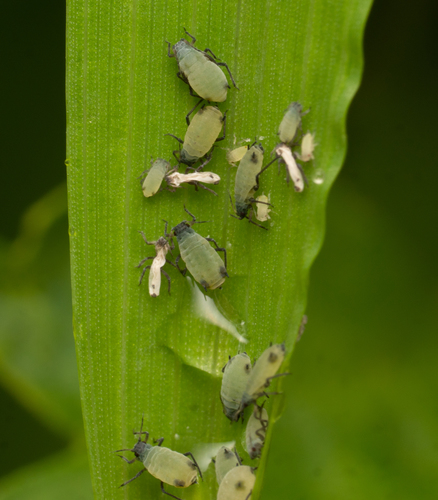
Photo: no rights reserved (CC0 1.0)
How to identify it
Wingless females green or whitish-green with darker head, legs, cornicles and bands; colonies in the whorl and on the tassel.
Damage
Sap feeding, honeydew and sooty mould on tassels; can spread maize viruses.
Prevention
Conserve natural enemies; nectar plants such as marigold attract them.
Natural enemies
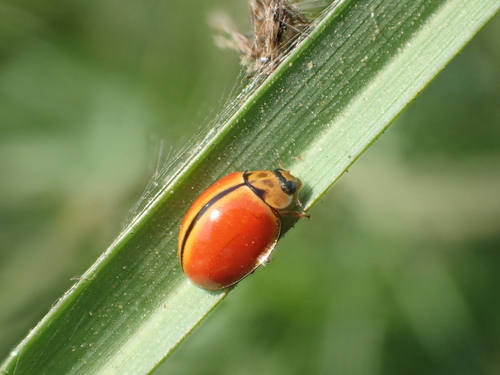
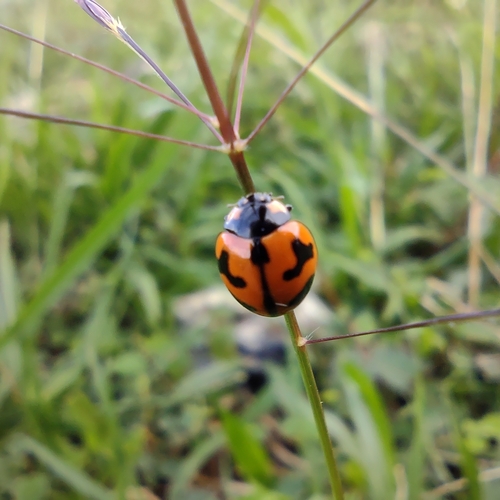
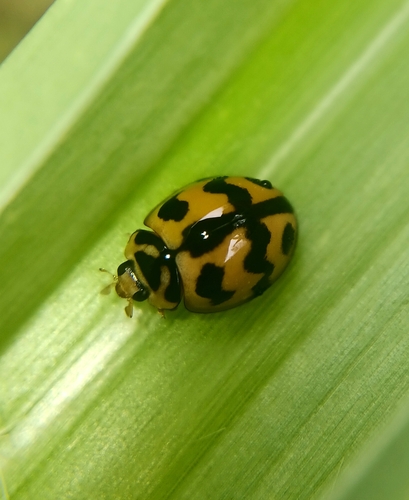
Aphid parasitoids (Aphidius, Diaeretiella, Aphelinus), ladybirds and lacewings.
When to act
No published threshold found yet; set one for your farm in the ENTOCULA field map.
Insecticide only as a last resort, when monitoring shows the threshold is reached and natural enemies are not keeping up. Use only FPA-registered products for this crop and pest, at label rate, with protective equipment, and respect the pre-harvest interval. Rotate insecticide groups to slow resistance.
Limited sources so far. Check with your municipal agriculturist.
Photo: (c) Guy Babineau, some rights reserved (CC BY) (CC BY 4.0)
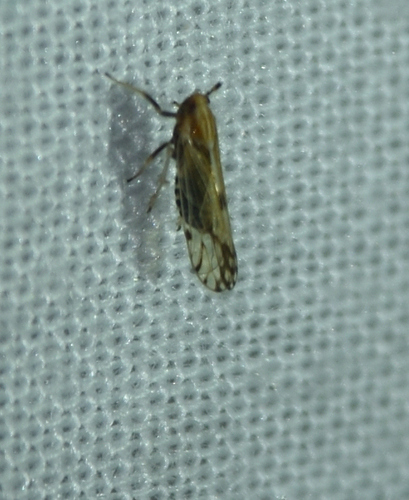
How to identify it
Corn planthopper: yellow with dark brown to black markings, 2-3 mm, wings longer than the body; eggs laid in the leaf midrib.
Damage
Sap feeding on corn; vector of maize viruses.
Prevention
Synchronous planting; remove volunteer corn and grassy hosts.
When to act
No published threshold found yet; set one for your farm in the ENTOCULA field map.
Insecticide only as a last resort, when monitoring shows the threshold is reached and natural enemies are not keeping up. Use only FPA-registered products for this crop and pest, at label rate, with protective equipment, and respect the pre-harvest interval. Rotate insecticide groups to slow resistance.
Photo: (c) Gabriel Cerino Rieper, some rights reserved (CC BY) (CC BY 4.0)
How to identify it
Eggs: clusters of about 300 covered with brown hairs.
Larva: velvety, 35-40 mm when grown, dark with yellowish-green stripes and white side bands; young larvae greenish.
Adult moth: stout, forewings pale grey to dark brown with wavy white lines; active at night.
Damage
Young larvae scrape leaves to a papery white; older larvae eat holes, skeletonise leaves and bore fruit; can cut seedlings.
Prevention
Field sanitation; destroy egg masses and groups of young larvae.
Castor as a trap crop along borders; light traps and pheromone traps for monitoring.
Keep rice fields flooded (rice).
Natural enemies
Egg and larval parasitoids, predators, and fungal and viral diseases; Bt, NPV and neem on young larvae.
When to act
No published threshold found yet; set one for your farm in the ENTOCULA field map.
Insecticide only as a last resort, when monitoring shows the threshold is reached and natural enemies are not keeping up. Use only FPA-registered products for this crop and pest, at label rate, with protective equipment, and respect the pre-harvest interval. Rotate insecticide groups to slow resistance.
Limited sources so far. Check with your municipal agriculturist.
Photo: (c) portioid, some rights reserved (CC BY) (CC BY 4.0)
How to identify it
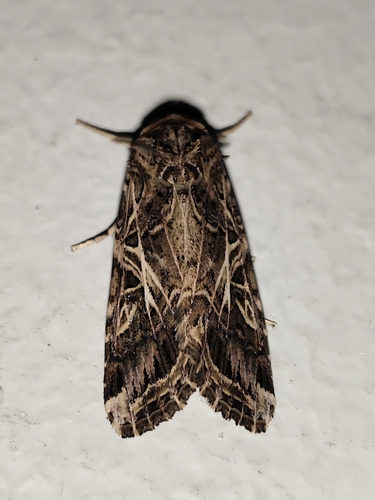
Adult: drab brown-grey moth, wingspan 26-32 mm, with a pale round spot on the forewing.
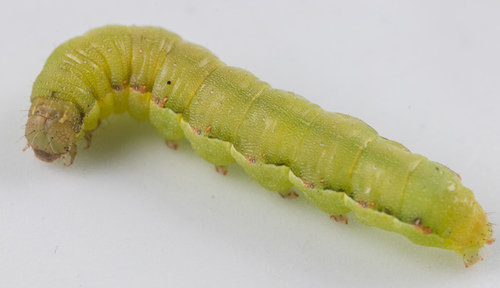
Larva: green to dark, with pale lines along the body.
Damage
Leaf feeding and skeletonising; also bores into fruit and heads.
Prevention
Remove weeds and crop residues; hand-pick egg masses.
Natural enemies
Parasitoids and diseases; Bt and NPV products.
When to act
No published threshold found yet; set one for your farm in the ENTOCULA field map.
Insecticide only as a last resort, when monitoring shows the threshold is reached and natural enemies are not keeping up. Use only FPA-registered products for this crop and pest, at label rate, with protective equipment, and respect the pre-harvest interval. Rotate insecticide groups to slow resistance.
Limited sources so far. Check with your municipal agriculturist.
Photo: (c) Joan Evangelista, some rights reserved (CC BY) (CC BY 4.0)
How to identify it
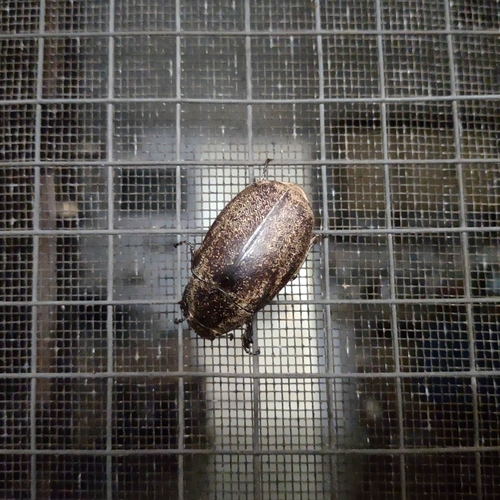
Grub: C-shaped, dirty white, in the root zone (white grub).
Adult: scarab beetle that emerges seasonally to mate and lay eggs.
Damage
Grubs eat roots: plants wilt, yellow and die in patches. One of the most destructive soil pests of sugarcane and corn in the Philippines.
Prevention
Community-wide collection of beetles for about three weeks from the first emergence, before they lay eggs.
Collect and destroy grubs during ploughing and tillage; thorough cultivation exposes grubs to birds, earwigs and fire ants.
Natural enemies
Birds, earwigs and fire ants; Metarhizium and Beauveria fungi and nematodes attack grubs.
When to act
No published threshold found yet; set one for your farm in the ENTOCULA field map.
Insecticide only as a last resort, when monitoring shows the threshold is reached and natural enemies are not keeping up. Use only FPA-registered products for this crop and pest, at label rate, with protective equipment, and respect the pre-harvest interval. Rotate insecticide groups to slow resistance.
Unreviewed guide. Written from the cited sources (IRRI, PhilRice, UPLB, CIMMYT, Pacific Pests, Government of India IPM packages, Wikipedia) and retrieved 2026-11-12. Use only FPA-registered pesticides, at label rates. Check local recommendations with your municipal agriculturist.